 Deutsch
 English
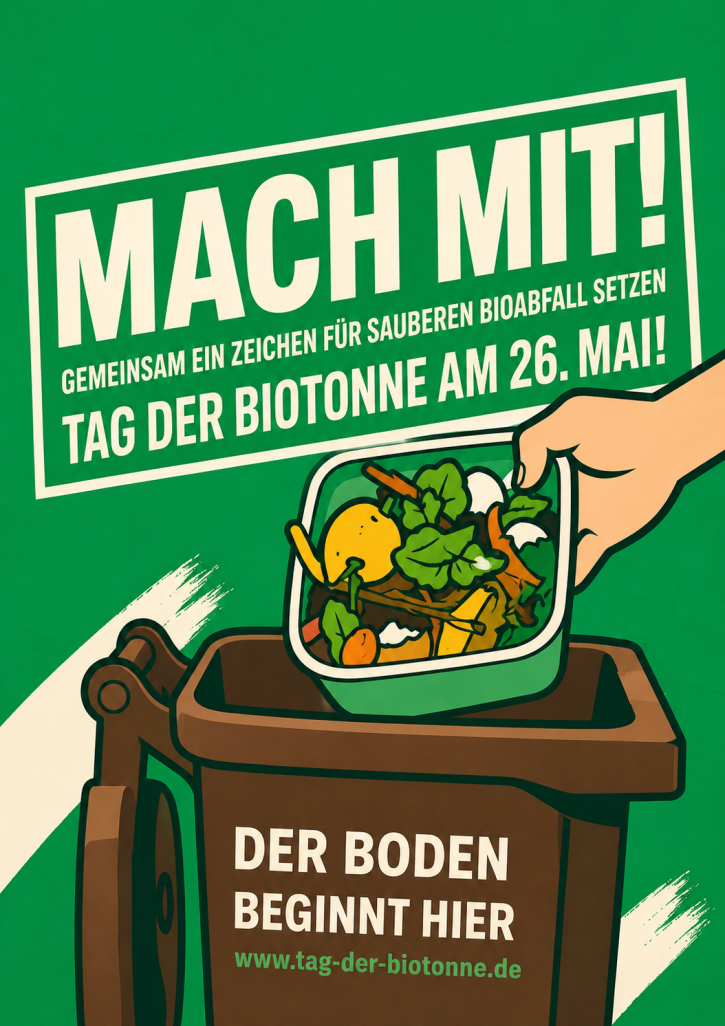
The separate collection of organic waste in the organic waste garbage can makes Germany less dependent on imported artificial fertilizers. Federal Environment Minister Carsten Schneider pointed this out on the occasion of Organic Waste Bin Day on May 26. The current international crises show that dependence on imported fertilizers can further increase food prices.
Federal Environment Minister Carsten Schneider: "Biowaste is not waste, but a valuable resource - if it is properly utilized, it can be turned into new energy and fertile soil. The production of biogas can replace fossil fuels. Compost on agricultural land also makes energy-intensive and mostly imported mineral fertilizers superfluous and supports humus formation. Compost is also used as a substitute for peat in soil production. This protects our moors! In this way, separately collected organic waste contributes to climate and resource protection in several ways and makes us less dependent on imports."
Potato peelings, coffee grounds, wilted flowers and other compostable kitchen and garden waste make up the largest waste fraction in private households at around 10 million tons per year. "The contents of our organic waste garbage cans are used to produce valuable compost, most of which is used as a natural fertilizer and soil conditioner in agriculture," said Uwe Feige, VKU Vice President, in Berlin.
NABU President Jörg-Andreas Krüger also emphasized the great importance of biowaste in Berlin: "Biowaste is one of the most valuable domestic raw materials we have. The compost produced from it not only replaces expensive artificial fertilizer and peat, the extraction of which is harmful to the climate, but recycling plants are also increasingly producing biogas in addition to compost. This promotes independence from gas imports - a contribution to the security of our energy supply."
On Biobin Day, numerous municipalities, waste management companies and local groups across Germany are holding campaigns to draw attention to the relevance of the biobin. The aim is to sensitize the population to the correct separation of organic waste and to highlight the importance of this material flow for agriculture, climate and resource protection.
Frauke Bank, Head of Marketing at Berliner Stadtreinigung (BSR), said on the occasion of Organic Waste Bin Day: "We have been successfully promoting the correct separation of organic waste in Berlin for years. As a municipal waste management company, we welcome nationwide initiatives such as Organic Waste Bin Day, which strengthen our work on the ground. Every piece of organic waste that ends up in the organic waste garbage can instead of in the residual waste is a benefit for the environment and for a sustainable circular economy in Berlin".
David Wilken, Managing Director of BGK - Bundesgütegemeinschaft Kompost, which initiated the day of action, explained in Berlin: "With this year's slogan 'The soil starts here', we want to inform the public about the importance of producing and using high-quality compost to improve soils and maintain their quality. Cleanly separated biowaste can be used to produce compost and other organic fertilizers and soil improvers that can be used in many ways in conventional and organic farming, in private and public gardens and parks or to produce potting compost and vegetable soil.
Further information: Interested parties can find out which activities are taking place where on Organic Waste Bin Day at www.tag-der-biotonne.de.