 Deutsch
 English
Bild



Biowaste is compostable organic waste that can be recycled through composting.
This includes, among other things:
This waste is processed into compost at a certified composting facility.
You can find information here: Commercial Waste
Waste containers are emptied according to set collection schedules. You can view the dates under: Waste Collection Dates.
From December through February of each year, the collection schedule switches to a 14-day cycle. Collection takes place during even-numbered calendar weeks. Starting with calendar week 10, weekly collection resumes.
Placement
Unsealed waste containers must be placed at the edge of the public right-of-way (outside of traffic lanes) by 6:00 a.m. on collection day.
Alternatively, organic waste can be dropped off at recycling centers. However, this is subject to a fee for approved home composting and for commercial facilities.
For more information, please contact the Sales Department at vertrieb-ksj@jena.de.
You can find information here: Commercial Waste
When it comes to organic waste bins, there are recurring complaints about unpleasant odors in the summer and problems with emptying the bins in the winter. Following these tips can help:
Buying bags that are supposedly safe for the organic waste bin does nothing to help the environment—quite the opposite. These bags, of all things, are difficult to compost and can only be composted under certain conditions.
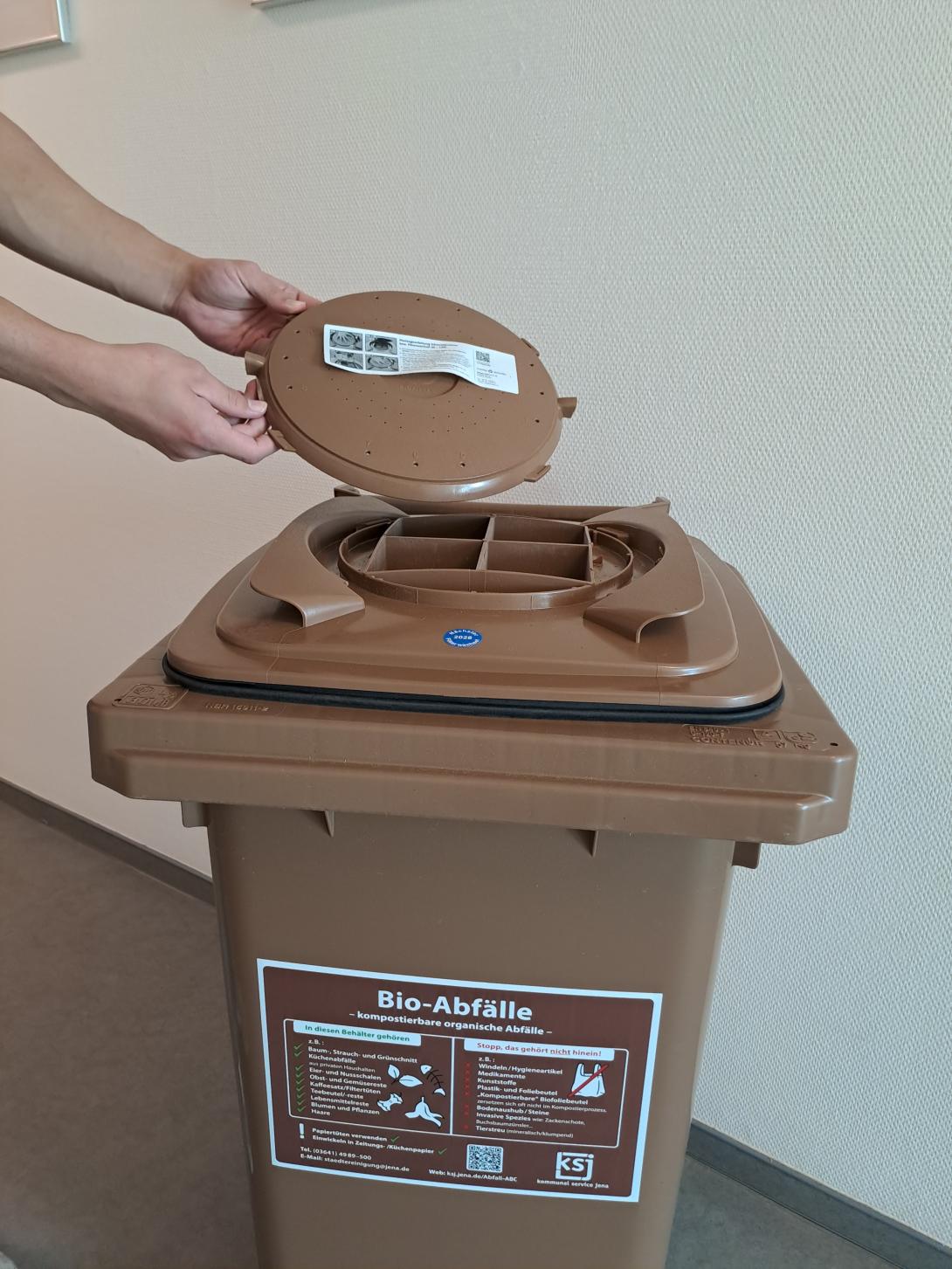
Deckel für 120 l Biotonnen mit integriertem Biofilter und elastischer Doppeldichtung
Ihre Vorteile:
Auch im Winter ein Plus: geringere Vereisungsneigung.
Bio-Tonne vorhanden?
Der Filterdeckel passt auf fast alle 120-Liter-Biotonnen.
Deckel nachrüsten
inkl. Montage und Filtermaterial
45,00 EUR inkl. Montage & Filter
Vorher Termin vereinbaren und die Tonne zur KSJ-Gebührenstelle bringen. Für die Montage bitte etwa einen Tag einplanen.
Neue Biotonne?
120-Liter-Behälter mit braunem Biologic-Deckel und Filtermaterial
Neue 120-Liter-Biotonne
inkl. braunem Filterdeckel und Filtermaterial
75,00 EUR
Bestellung über die Gebührenstelle des KSJ

We offer mini compost bins for purchase to collect kitchen and food waste at home. The 10-liter bin fits, for example, in built-in cabinets or under the sink. The bin is available for purchase, along with 10 compostable paper bags, at the KSJ Service Center/Cashier’s Desk (Löbstedter Str. 56) and at the Service Office (Saalstraße 8a, inside the Stadtwerke Jena Customer Center) for 6.50 EUR. Additional bags are available in stores, but can also be purchased at KSJ in packs of 10 for 1 EUR.
Lining the bin with newspaper is an alternative to using paper bags.
What goes inside?



Another option for disposing of organic waste from private households is to use a compost pile or a rapid composter in order to reuse the resulting compost.
Home composting should be carried out properly and safely at the point of generation or in the immediate vicinity (i.e., on the residential property or on a neighboring or opposite property). As a “home composter,” you can apply to the KSJ for a reduction in the basic waste fee. Once home composting is confirmed, the reduced base fee will take effect as of the next billing date. Any changes must be reported to the KSJ.
The fee reduction is only available for year-round home composting; it does not apply if a organic waste bin is used for disposal in addition to composting.
Making Good Compost


