 Deutsch
 English
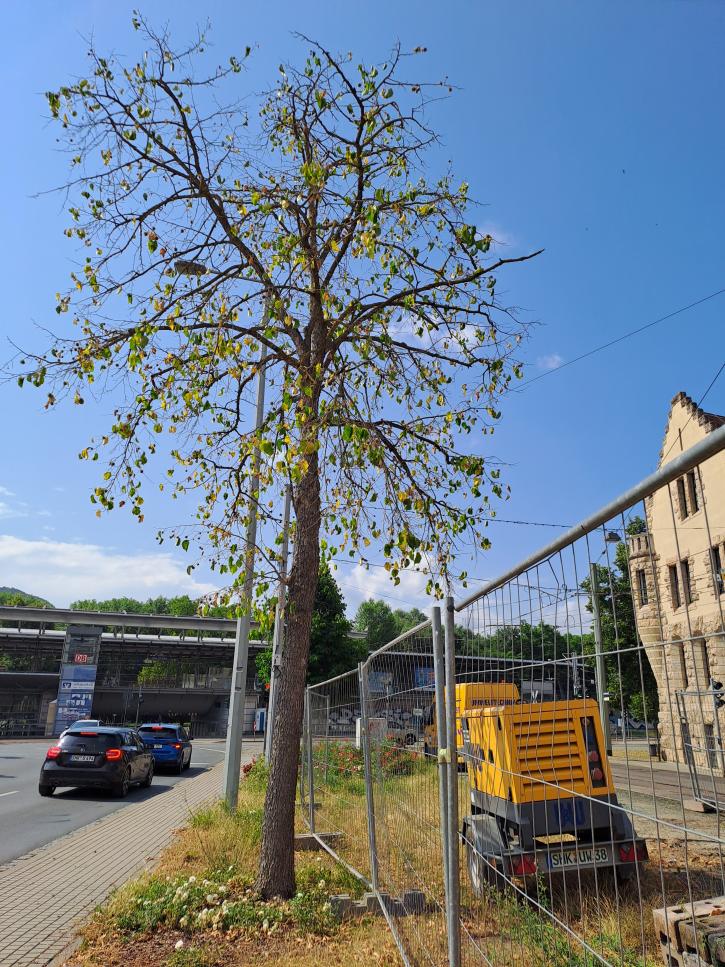
The effects of climate change are also clearly felt in Jena—especially by the city’s trees. Longer heat waves, a lack of rain, and dry soil are taking an increasing toll on the trees. Kommunalservice Jena (KSJ) is therefore stepping up its investments in irrigation, maintenance, and climate-adapted replanting to safeguard the city’s tree population in the long term.
Urban trees are essential for a healthy urban climate. They provide shade, cool their surroundings through evaporation, improve air quality, and reduce overheating in densely built-up areas. At the same time, they are particularly vulnerable to the effects of climate change. Thuringia is one of the regions in Germany experiencing particularly rapid warming. Droughts often begin as early as spring and last longer, while precipitation increasingly takes the form of heavy rain. However, this water barely seeps into the ground and cannot compensate for the lack of moisture in the soil.
The consequences are significant: Persistent water shortages inhibit tree growth. Trees produce more short shoots, their leaves change color, and they fall prematurely. In addition, parts of the crown die back, while the formation of new fine roots—which are crucial for water and nutrient uptake—is severely limited. Weakened trees are more susceptible to fungi, insect pests, and damage from the sun, storms, and falling branches. In urban areas, small tree pits, sealed surfaces, limited root space, and heated streets further exacerbate drought stress.
The KSJ cares for approximately 71,100 urban trees; a total of about 77,500 trees are registered in the tree registry. After several years of drought, numerous trees—including older ones—have already died. At the same time, the effort required for irrigation has increased significantly. Currently, 2,273 young trees are being watered in shifts using an 8,000-liter water truck, while an additional 264 trees in hard-to-reach locations are being watered with a Multicar. Specialized gardening and landscaping companies are also assisting with the watering.
Young trees are particularly dependent on regular watering during their first three to five years, as their roots have not yet reached deeper water reserves. For this reason, the KSJ places greater emphasis on climate-adapted tree species when planting new trees. Supplemented by proven native species and a high level of biodiversity, this creates a resilient urban tree population. Despite the challenges, replanting continues steadily in Jena. Many street and infrastructure projects are even creating additional tree sites—including on Leipziger Straße, the Tatzendpromenade, on Hufelandweg, along the Ostbad bike path, on Maria-Pawlowna-Straße, at the Lichtenhainer Bridge, in the Ölste residential area, on Thomas-Mann-Straße, on Nollendorfer Straße, and currently on August-Bebel-Straße.
Citizens can help, too: During dry spells, young trees should be watered less frequently but thoroughly—with 60–100 liters of water—ideally in the morning or evening. In addition, tree pits should not be used for parking or compacted. Damage can be reported via the City of Jena’s defect reporting system at https://maengelmelder.jena.de, specifying the tree number. Tree donations also make an important contribution. Further information can be found here:Tree Sponsorships | Tree Donations | KommunalServiceJena.
The goal of KSJ remains to maintain a healthy, species-rich, and climate-resilient urban tree population that ensures a livable and green city for future generations as well.